
Almost everyone writing for search now starts with AI. Most of what they publish ranks nowhere.
I get asked some version of the same question constantly: we’re using AI for our SEO content, so why isn’t it working? The answer is almost never the prompt. It’s what happens to the draft after the model stops typing.
A model will hand you a clean, confident, structurally correct draft in seconds. None of that is what ranks. What ranks is the layer most people skip: editing the draft against real expertise, checking every claim, and adding the things a model can’t produce. Skip it and you’ve published slop, just faster than before.
This post is the process I use to turn an AI draft into something that ranks: where AI actually helps, the editing steps that matter, how to fact-check what the model gives you, and the tells to cut before anything goes live.
What AI actually gives you: a draft
AI delivers a fast first draft. That draft is raw material, not a finished asset.
The model assembles patterns from its training data. It has no access to your test results, your customer data, or your point of view, so it can’t put any of them on the page. It will state facts it can’t check and write “in my experience” about experiences nobody had. The draft is the starting line, and treating it as the finish line is the whole problem.
I’ve argued the why in is AI content bad for SEO: Google ignores content that adds nothing new, whatever produced it. And AI content strategy that ranks covers what to point AI at in the first place. This post is the execution layer between those two: the editing process that turns a generated draft into a page worth ranking.
The process: turn an AI draft into content that ranks
Here’s the order I work in. The first three steps add what the model couldn’t; the last two make sure search and AI can use the result:
- Start from first-hand input: Before you touch the prose, give the draft something only you have: a test you ran, a screenshot you took, a number from your own analytics, a position you’ll defend. If the brief was thin, the draft is thin, and no amount of editing fixes empty.
- Check every claim against its source: Treat every stat, date, and product detail as wrong until you’ve confirmed it. This is the step most teams skip because it’s the slowest, and it’s the one that separates a publishable draft from confidently wrong content a reader can catch. More on how below.
- Add what the model can’t generate: Original data, your own screenshots, a real opinion. The content that gets cited in AI answers is the content carrying something a model couldn’t have written on its own. Adam Gnuse’s analysis of 150,000 pages found trends-and-analysis content earned LLM citations 78% of the time against 12% for generic how-to content. That gap is the value of the part you add.
- Edit out the tells: Cut the patterns that signal machine-default writing. Readers and search systems both spot them now. The full list is below.
- Structure it for retrieval: Lead each section with the answer, keep it on the surface rather than behind accordions, and mark it up with schema. AI search grabs passages, not whole pages, so each section has to stand on its own. Michael King of iPullRank describes modern AI search as agentic: it retrieves, re-retrieves, and grades its own drafts before answering, so content has to “win at five different moments” you can’t see.
AI gives you the draft. You add the ranking.
Verify like it matters: go to the primary source
AI produces plausible, confident, wrong facts, and it gives you no signal about which ones are wrong. So the rule is simple: every claim gets traced to its primary source before it goes live. The vendor’s own documentation. The researcher’s own publication. The release note from the company that shipped the thing.
Not the roundup that cites them. Secondary summaries drift. They rename lists, round numbers, and drop caveats, and you inherit every one of those errors if you stop at the summary.
A concrete example from my own desk. Last week a draft cited a well-known SEO blog’s summary of Google’s new GA4 “AI Assistant” channel, which said it groups traffic from ChatGPT, Claude, and Perplexity. Google’s own release note says ChatGPT, Gemini, and Claude. The summary had quietly swapped one name. If that line had shipped, the post would have stated, with total confidence, something Google’s own documentation contradicts.
This is not pedantry. A fabricated or drifted fact is an E-E-A-T problem, the experience, expertise, authoritativeness, and trust that Google’s own guidance frames quality around. One checkable error a reader catches puts every other claim on the page in doubt. Verification is the cheapest trust you can buy, and the part AI cannot do for you, because it cannot tell when it is wrong.
Edit out the tells: the patterns that scream “AI wrote this”
Readers spot machine-default writing instinctively now, and the patterns are well catalogued. Wikipedia’s “Signs of AI writing” is the most thorough public reference. Here are the ones I cut on every pass, what each signals, and what to do instead.
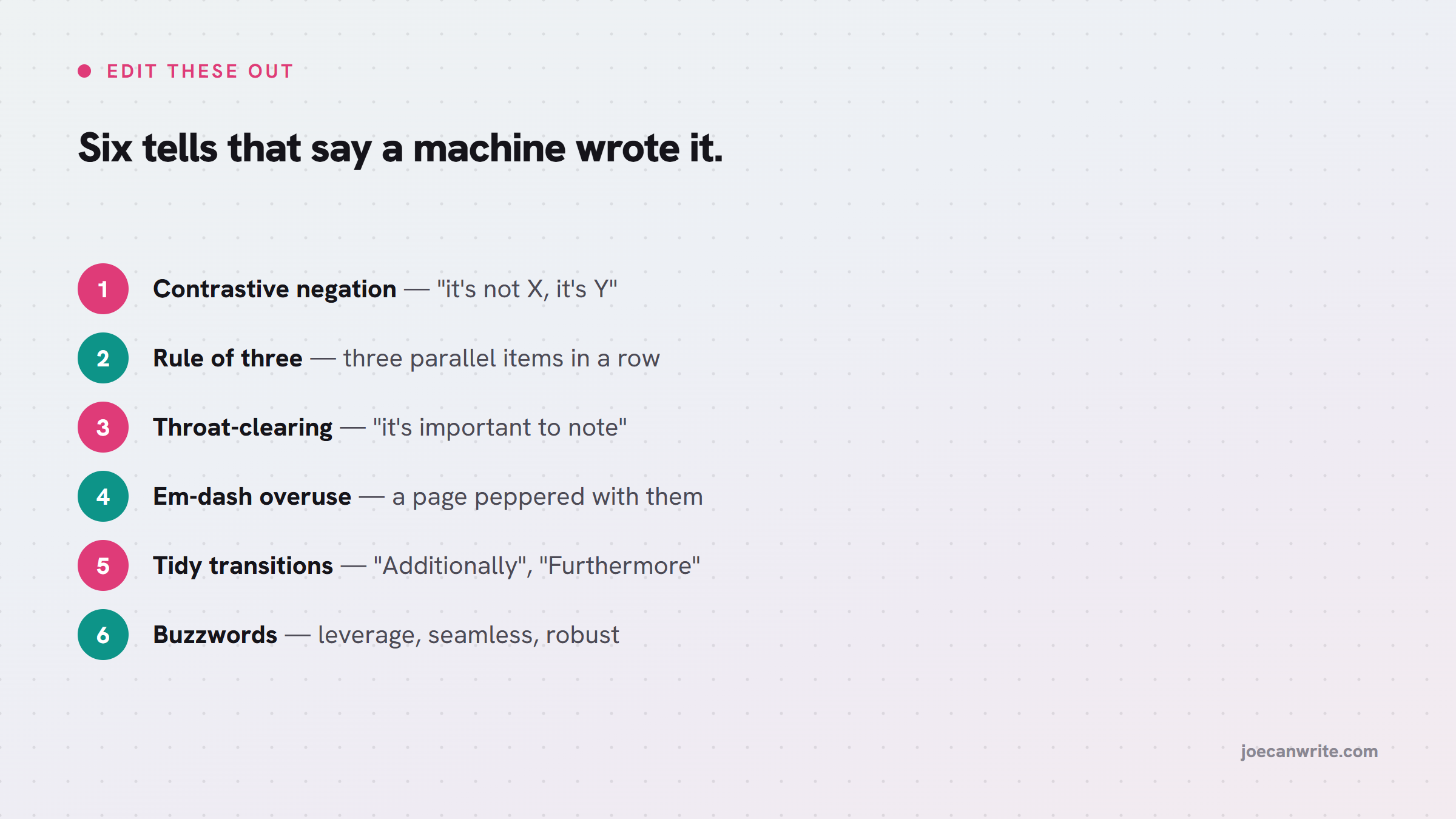
- Contrastive negation: The “it’s not X, it’s Y” construction, and its cousins (“not just X, but Y”). It’s the single strongest tell, because models reach for it constantly. Say the point straight instead, or flip the order so it reads less like a template.
- Rule of three: Three parallel items or clauses in a row, over and over. This is the one I have to watch hardest, because I reach for it naturally, but it’s a common tell, so I catch it on the edit. One in a section is fine. Three is a pattern, and patterns read as generated.
- Throat-clearing: “It’s important to note,” “needless to say,” “in today’s landscape.” Filler that delays the point. Cut it and start with the point.
- Em-dash overuse: Models love the em-dash. A page peppered with them looks machine-set. Aim for a handful, and replace the rest with commas, colons, or full stops.
- Uniform rhythm and tidy transitions: Every paragraph the same length, every section bridged with “Additionally” or “Moreover.” Vary the lengths and let ideas connect on their own.
- Buzzwords: Leverage, seamless, robust, transformative, cutting-edge. They add nothing and they date the writing instantly. Use the plain word.
None of this is about hiding that AI was involved. It’s editorial craft, the same standard good editors always applied, pointed at a new kind of first draft.
Don’t try to game the detectors
There’s a tempting wrong turn here: running the draft through a “humanizer” tool that rewrites it to slip past AI detectors. That solves a problem you don’t have.
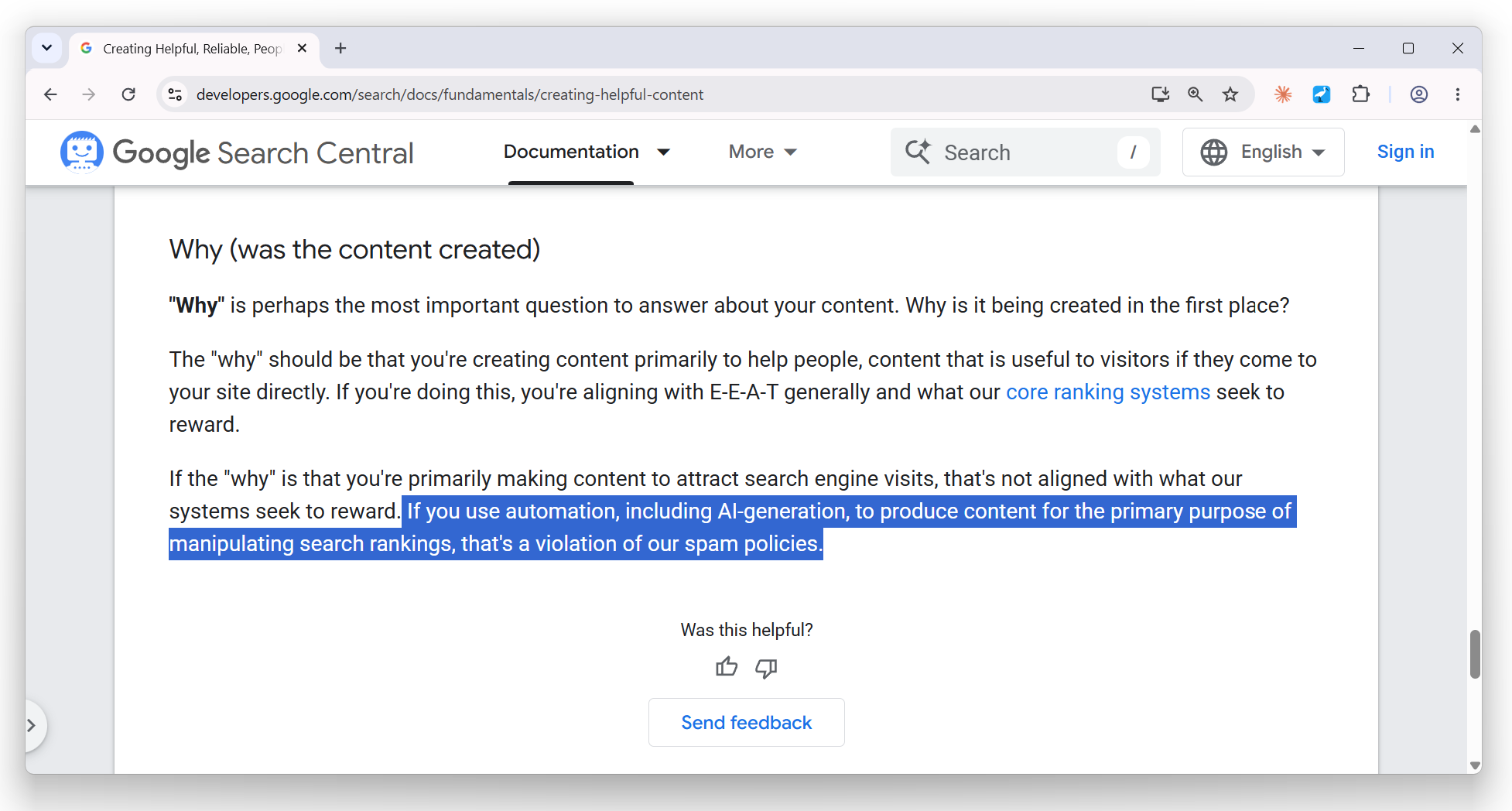
Google’s position is on the record. Its spam policy targets content made “for the primary purpose of manipulating search rankings,” not a writing style. It rewards helpful, original content however it’s produced. A detector score is not a ranking factor, and the detectors themselves are famously unreliable, flagging human writing and clearing machine writing often enough that no serious editor trusts them.
Gaming a detector gets you text that passes a scan and still says nothing. The work that actually moves rankings is the opposite of obfuscation: adding substance, checking facts, and editing for a real reader. Spend the effort there.
Before you publish: the final pass
One last sweep before anything goes live. It takes about twenty minutes and it decides whether the piece ranks or joins the pile.
- Run the tells pass on the finished draft, top to bottom.
- Confirm every stat, date, and claim links to a primary source.
- Check that each section answers its question on the surface, with nothing important hidden behind a tab or accordion.
- Add an FAQ section and the right schema so search and AI can lift the content cleanly.
If a claim can’t be sourced, it comes out. If a section reads like it could appear on any competitor’s site, it gets the first-hand detail that makes it yours.
The edit is the ranking
Using AI for SEO is fine. Publishing what it gives you is the mistake. The ranking was never in the prompt; it’s in the editing and verification layer, the part that needs a person with real expertise and the patience to check.
Here’s the first step I’d take today: pick your most-trafficked AI-assisted post, and run two passes on it. The verification pass, tracing every claim to its source. The tells pass, cutting the patterns above. You’ll usually find at least one unsupported claim and a handful of tells, and fixing them is the difference between a page that competes and a page that fills space.
Want content built to a standard that ranks? I’m Joe Fylan, a content strategist and writer for WordPress, SaaS, and eCommerce companies. I plan and write content that gets found and gets cited, with every claim verified and every page built to earn its place. If that’s the standard you want, tell me about your project.
FAQs
Can you use AI for SEO content without getting penalized?
Yes. Google’s spam policy targets content made to manipulate rankings, not the use of AI itself, and it rewards helpful content however it’s produced. The risk isn’t a penalty for using AI; it’s publishing raw, unedited, unverified output that adds nothing. Edit and fact-check it to a human standard and there’s nothing to penalize. More in is AI content bad for SEO.
How do you edit AI content so it ranks?
Add what the model couldn’t: first-hand experience, original data, a real position. Verify every claim against its primary source. Cut the AI tells (contrastive negation, rule of three, throat-clearing, em-dash overuse, buzzwords). Then structure each section to answer one question on the surface, with schema. The edits add the substance and accuracy that ranking and AI citation both reward.
How do you fact-check AI-generated content?
Treat every claim as wrong until confirmed, and trace each one to its primary source, the vendor’s own docs or the researcher’s own publication, never a secondary roundup. Summaries drift: they rename lists, round numbers, and drop caveats. When two sources disagree on a detail, the primary source wins.
Should you use an AI humanizer tool?
No. Humanizer tools rewrite content to evade AI detectors, which solves a problem that doesn’t affect rankings. Detector scores aren’t a Google ranking factor, and the detectors are unreliable anyway. The effort is better spent on substance, verification, and editing for a real reader.
How do you tell if content reads as AI-written?
Look for the catalogued tells: contrastive negation (“it’s not X, it’s Y”), rule-of-three padding, throat-clearing phrases, em-dash overuse, uniform paragraph lengths with tidy transitions, and buzzwords like “leverage” and “seamless.” Wikipedia’s “Signs of AI writing” is a thorough reference. Most machine-default drafts carry several of these at once.